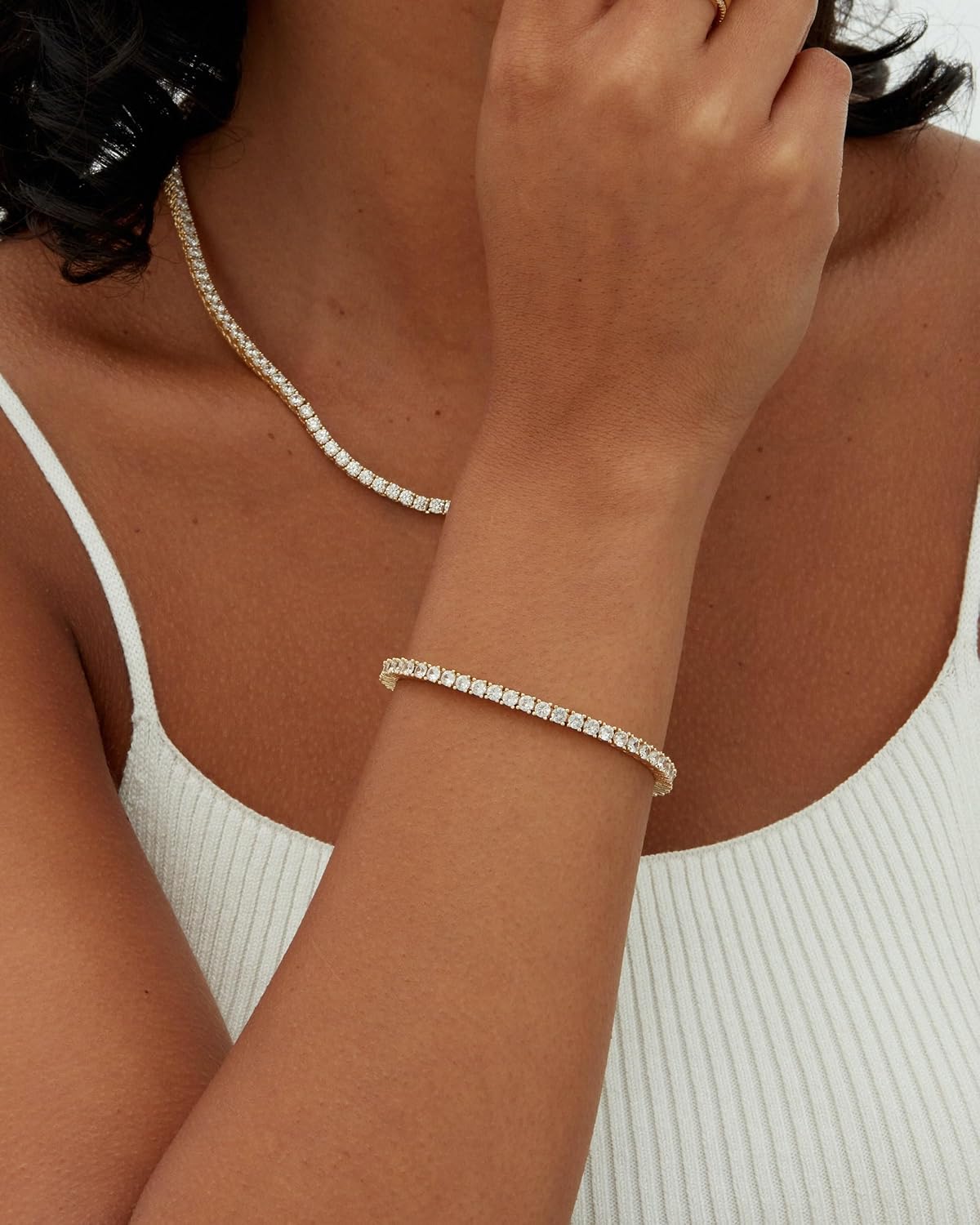
A tennis bracelet is exactly what it sounds like once someone explains the origin: a flexible line of individually set gemstones — originally diamonds — that wraps the wrist in a continuous row of sparkle. The name comes from a 1987 US Open moment when player Chris Evert stopped a match to search for a diamond bracelet that had slipped off her wrist, and a category was born. Today, the design is everywhere, in price points from $30 to $30,000, and the stones inside those settings range from cubic zirconia (a synthetic glass-like stone, abbreviated CZ) to moissanite (a lab-grown silicon carbide crystal that rivals diamond in hardness) to genuine diamonds. What most listings don’t tell you is that the stone choice is only half the decision. The clasp — the mechanism that keeps the bracelet on your wrist — is often the cheapest part of an otherwise well-made piece, and it’s the detail most likely to cost you the bracelet entirely. This guide is built for buyers who already know the vocabulary and are now weighing specific tradeoffs: which stone for which budget, which clasp construction to demand, and how to read a listing that buries the important specs in the fourth photo.
CZ vs. Moissanite: The Tradeoff Is Longevity, Not Looks
Both stones are visually convincing alternatives to diamond at arm’s length. The practical split happens over time and with wear.
Cubic zirconia is a zirconium dioxide crystal grown in a lab. It’s optically dense and inexpensive to produce, which is why CZ tennis bracelets dominate the under-$150 tier. The Gemological Institute of America’s consumer education materials note that CZ has a refractive index of roughly 2.15–2.18, compared to diamond’s 2.42 — which means CZ produces slightly less brilliance and more of a “glassy” look under close inspection. The more significant issue, per long-term owner reports aggregated across jewelry forums and retailer review sections, is surface durability: CZ rates 8–8.5 on the Mohs hardness scale, and everyday wear — particularly the friction of a bracelet against a desk, keyboard, or sleeve — gradually dulls the facets. Most owners report noticeable haziness in CZ tennis bracelets within 18–36 months of daily wear. For gifting, travel jewelry, or occasional wear, that timeline is perfectly acceptable. For a daily-driver piece, it’s a meaningful cost.
Moissanite sits at 9.25–9.5 on the Mohs scale, just below diamond at 10. As Jewelry Shopping Guide’s comparison of CZ vs. moissanite explains, that extra hardness translates to facets that hold their polish significantly longer — most owners report no perceptible dulling with years of daily wear, provided the setting itself holds up. Moissanite also carries a higher refractive index than CZ (2.65–2.69), which produces more fire — the colored light dispersion you see when a stone catches light at an angle. For some buyers this reads as more brilliant than diamond; for others it reads as slightly “disco.” This is genuinely a stylistic preference, not a quality hierarchy, and Vogue’s coverage of the tennis bracelet’s ongoing fashion revival has noted moissanite specifically as the stone of choice for buyers who want maximum wrist presence without diamond pricing.
The price gap is real but compressible as you move up the quality ladder:
| Stone | Typical 7” bracelet price range (2026) | Longevity with daily wear |
|---|---|---|
| CZ (gold-plated base) | $30–$150 | 18–36 months before visible dulling |
| CZ (sterling silver or vermeil) | $80–$250 | Same stone longevity; metal holds better |
| Moissanite (silver or 10k gold) | $200–$600 | 5+ years with minimal visible wear |
| Moissanite (14k gold) | $500–$1,800 | Indefinite with occasional professional cleaning |
| Natural diamond (10k–14k gold) | $800–$5,000+ | Indefinite |
One note on moissanite grading: unlike diamonds, moissanite is not graded by GIA on the standard 4Cs scale (cut, color, clarity, carat). Most moissanite sold in the US comes from Charles & Colvard, which uses its own DEF and GHI color designations. Per Brides’ tennis bracelet overview, DEF moissanite reads as near-colorless to the naked eye under most lighting — which is what you want for a white-metal setting. GHI grades can show a faint yellow or greenish cast under certain lights, which is more visible in a tennis bracelet than in a solitaire because you have dozens of stones side by side amplifying any color variance.
The Clasp Problem: What “Safety Clasp” Actually Means
This is the section most buying guides skip, and it’s the one that matters most for a tennis bracelet specifically. Unlike a chain, which can be re-clasped easily if it pops open, a tennis bracelet can slide off in a single motion the moment its clasp fails. The design — a continuous flexible line with no secondary anchor — means clasp engineering is load-bearing in a way it simply isn’t for other bracelet types.
Box clasp with figure-8 safety: This is the baseline for any tennis bracelet worth recommending. The box clasp is a rigid tongue-and-box mechanism; the figure-8 (also called a safety-8) is a small folding metal tab that flips over the tongue to prevent accidental release. You need both. A box clasp alone can release from lateral pressure — exactly the kind of pressure a bracelet experiences against a tabletop or while pulling on a jacket. The Knot’s tennis bracelet buying guide specifically flags the figure-8 safety as a minimum specification for tennis bracelets in the $200+ range, noting that listings that photograph only the front of the bracelet and describe the closure only as “secure clasp” are often omitting the safety detail because there isn’t one.
Fold-over clasp with push-button release: Common in mid-range pieces, this clasp uses a hinged mechanism that folds flat and locks with a side button. It’s comfortable — no hard edges — and generally more resistant to accidental opening than a bare box clasp. Look for a double-lock version, sometimes listed as a “double fold-over” or “double safety,” which adds a second locking tab. Owners in long-run retailer reviews consistently identify the fold-over with double safety as the most reliable non-professional-grade clasp for daily wear.
Lobster clasp on a tennis bracelet: Treat this as a red flag. Lobster clasps are designed for chains where you’re clipping the clasp to a jump ring; on a tennis bracelet they create an asymmetric weak point and provide no secondary safety. Several high-volume online sellers use lobster clasps on tennis bracelets priced under $80 because they’re cheap to manufacture. The bracelet will look identical in product photography. Check the clasp detail photo specifically, and if it isn’t shown, ask.
Clasp metal quality on plated pieces: On gold-plated or vermeil bracelets, the clasp is often made from the same base metal as the bracelet body — usually brass or sterling silver — with the same plating applied. Plating wears first at friction points, and the clasp hinge is the highest-friction point on the piece. Owners of lower-cost plated tennis bracelets consistently note that the clasp shows wear (green tinting, plating loss, stiffness) before the bracelet body does. If you’re buying a plated piece for regular wear, budget for a re-plating or replacement within 12–18 months, or allocate slightly more budget for a sterling silver or 10k gold clasp body.
Setting Style: Prong vs. Bezel, and Why It Affects Stone Security
The setting — the metal structure that holds each stone in place — is the third variable most listings underdescribe.
Four-prong settings are the classic tennis bracelet construction. Each stone sits in a small basket of four metal points that grip the girdle (the stone’s widest edge). Prong settings maximize light exposure to the stone, which is why they produce more sparkle. The tradeoff is that prongs can catch on fabric and, over time, can bend or wear down — particularly in softer metals like 10k gold or sterling silver. For CZ stones, a bent prong is a lost stone; CZ is too inexpensive to justify a repair visit, and the stone will simply fall out. For moissanite or diamond, prong maintenance (re-tipping prongs, re-setting loose stones) is a standard and affordable jeweler service, typically $15–$40 per stone depending on market and location.
Bezel settings encase each stone in a continuous metal rim. They’re more secure — stones almost never fall out of a well-made bezel — and they have no prongs to catch on fabric. The visual tradeoff is reduced sparkle: the metal rim covers more of the stone’s edge, limiting light entry from the sides. Bezel tennis bracelets read as more modern and minimal, and Vogue’s 2025 tennis bracelet trend coverage specifically noted the bezel silhouette as the preferred format among contemporary fine jewelry designers working in the $800–$2,500 range.
Channel settings sit between the two: stones are set into a continuous groove of metal, held by two parallel rails rather than individual prongs or full bezels. Channel settings offer good stone security and a clean visual line, but they can be harder to repair — a loose stone in a channel setting sometimes requires the entire section to be re-set.
The “If X, Then Y” Decision Rule
Here’s how to translate all of the above into an actual purchase decision:
If you’re buying for occasional wear, gifting, or travel: CZ in sterling silver or vermeil, with a box-clasp-plus-figure-8, is the honest choice. Don’t spend more than $150 here. The stone will dull before it breaks, and the price reflects that lifecycle.
If you want a daily-driver piece under $600: Moissanite in sterling silver or 10k gold, four-prong or bezel setting, with a fold-over double-safety clasp. In this range, Charles & Colvard DEF color is achievable and worth specifying. This is the tier where the stone outlasts the clasp if you don’t vet the clasp explicitly — so do.
If you’re spending $800 or above: The stone decision becomes a values question (moissanite vs. natural diamond), not a durability question — both will last indefinitely with basic care. Put your evaluation energy into metal quality (14k minimum), setting construction, and the clasp mechanism. At this price, a jeweler’s inspection before purchase is reasonable to request. Brides’ buying guide recommends asking specifically whether the clasp includes a secondary safety lock and whether the settings have been checked for even stone seating before shipment.
If the listing doesn’t show the clasp clearly: Ask before you order, or pass. A seller confident in their clasp construction will show it. The ones who photograph only the front of the bracelet are often hiding the detail that differentiates a $40 clasp from a $4 one.
The stone is what draws the eye. The clasp is what keeps the bracelet on your wrist. Both decisions deserve the same attention — and most listings are betting you won’t notice the second one until it’s too late.