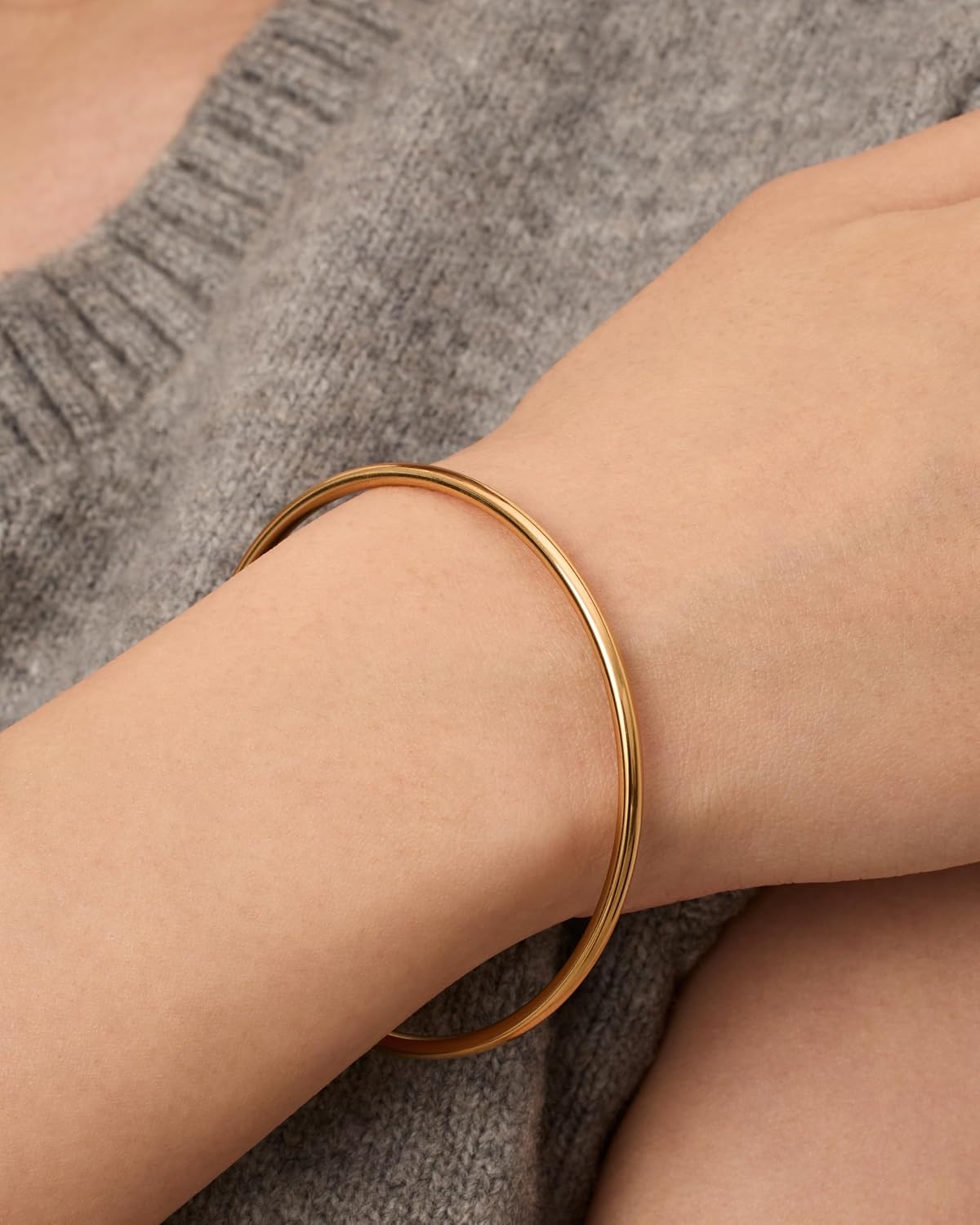
Stackable bangles — thin, rigid or semi-rigid bracelets designed to be worn several at a time on the same wrist — have become one of the most accessible entry points into personal jewelry. You slide three or five onto your wrist, they catch light as you move, and suddenly a plain outfit looks considered. At under $25 for a full set, the appeal is obvious. The catch is just as obvious once you’ve owned a set that turned your wrist green inside a week, left a rust ring on a white sleeve, or snapped at the seam the second time you put it on. This guide is about learning to see those failure modes before you buy, not after — by reading the construction signals that separate a functional budget set from a one-season regret. If you’re a first-time buyer, you’ll get a plain framework. If you’re a stylist or an enthusiast who has already burned through a few bad sets, you’ll get the specific tradeoffs to start filtering on.
Why Budget Bangles Fail (and What the Good Ones Do Differently)
The failure cascade in cheap bangles almost always starts with the base metal, not the finish. Most sets in the $8–$25 range are made from one of three base materials: brass, zinc alloy (sometimes sold under the trade name “white metal”), or iron-core wire. Each behaves differently under wear.
Brass is the most respected base in this tier. It’s an alloy of copper and zinc, relatively dense, and holds shape under light impact. More importantly, brass accepts electroplating — the thin decorative layer of gold- or silver-toned metal applied to the surface — better than zinc alloy does, because its surface is more uniform. Jewelry Shopping Guide’s breakdown of metal tiers notes that brass-base pieces consistently outperform zinc-alloy base pieces in plating durability at equivalent layer thicknesses, largely because zinc alloy’s porous structure causes the plating layer to lift earlier.
Zinc alloy is cheaper to cast into detailed shapes, which is why it dominates highly decorative sets with scrollwork or engraving. The tradeoff is real: zinc alloy is more brittle at thin cross-sections, and its porosity means the plating (the outer gold- or silver-tone layer) loses adhesion faster under sweat and friction. A thin zinc bangle that snaps at the seam after moderate wear is doing exactly what its material predicts.
Iron-core wire appears in some of the cheapest coiled or wrapped bangle styles. It is the hardest to recommend: iron rusts, and even a thin plating layer over iron will allow rust to wick through to skin contact points within weeks of regular wear.
The practical read: if a listing doesn’t specify the base metal, treat that as a yellow flag. Brass-base listings will almost always say “brass” because it’s a selling point. Zinc alloy listings will often say “alloy,” “metal alloy,” or nothing at all.
The Plating Thickness Question (and Why It Matters at $25)
Here’s where intermediate buyers often get stuck: two sets can both say “18k gold plated” and perform completely differently. The FTC’s guidelines for the jewelry industry — last substantially revised in 2024 — do not require a minimum plating thickness for a piece to be called “gold plated.” That means 0.5 microns of gold over brass and 2.5 microns of gold over brass both legally qualify as “gold plated.” The difference in longevity is significant.
The industry shorthand worth knowing:
By the numbers:
- Standard gold plating: ~0.5–1.0 microns. Fades noticeably within 3–6 months of daily wear.
- “Heavy gold plating” or “thick plating” claims: typically ~2.0–2.5 microns. Meaningfully more durable, though still not gold-filled.
- Gold-filled (legal FTC definition): must be at least 5% gold by weight, mechanically bonded. Rarely appears below $40 for a full bangle set.
- Vermeil (FTC): sterling silver base + minimum 2.5 microns gold plate. Also rarely seen under $25 for sets.
What this means practically: in the sub-$25 tier, you are almost certainly looking at standard gold plating over brass or alloy. That is fine as long as your expectations match. Refinery29’s stacking guide frames it well: budget plated bangles are a styling tool, not an investment — buy them for the look of a season, not the durability of a year. The honest question isn’t “will this last forever?” but “will this last long enough to be worth $12?”
The signal that separates a better-performing plated set from a worse one at this price is the base metal (brass wins) and the brand’s willingness to state plating specifications. Brands that publish those numbers — even approximate ones — tend to be operating with more quality control than brands that say only “gold tone.”
Construction Signals to Evaluate Before You Buy
Beyond base metal and plating, there are three physical construction details that who what wear’s editors and jewelry-focused community reviewers consistently identify as differentiators in the budget bangle category.
1. Seam quality on slip-on bangles. Most rigid bangles in this price range are formed by bending a strip or tube of metal into a circle and joining the ends. That join — the seam — is the stress point. Reviewers across multiple roundups consistently flag visible, raised, or sharp seams as a predictor of early breakage and skin irritation. A well-finished seam should be smooth to the touch and nearly invisible to the eye. In product photography, a clearly visible gap or rough join is a reliable skip signal.
2. Interior finish. The inside of a bangle sits against skin all day. Cheap sets often leave the interior unfinished or roughly stamped. Owners report that sharp interior edges cause wrist abrasion, especially on sets with multiple thin pieces stacking against each other and shifting during movement. This is hard to assess from a hero product photo — look for lifestyle shots that show the bangle on a wrist from the inside curve, or look for reviewer comments that specifically mention wearability.
3. Clasp or opening mechanism on adjustable bangles. Some budget sets include one “adjustable” bangle — a coiled or C-shaped piece — alongside the rigid slip-ons. Coiled styles have no clasp failure mode (there’s nothing to break), but they do shift and catch on fabric. C-cuffs at this price point are often too thin in cross-section to hold their shape after repeated opening and closing; owners frequently report that the metal bends permanently out of round after 4–6 weeks of regular wear. If the set includes a C-cuff and the cross-section looks very thin in photos, lower your durability expectations accordingly.
Building a Stack That Actually Works: The Decision Framework
At under $25, the goal isn’t to find the one set that performs like $200 jewelry. It’s to make smart choices about what to buy, in what quantity, for what purpose. Here’s how to think about it.
If you want a stack for a single event or short season: almost any brass-base set with a reasonable finish will do the job. Prioritize look and proportion over durability claims. Buy one set, wear it freely, and don’t expect it to survive 12 months of daily wear. Harper’s Bazaar’s styling coverage has noted that “disposable stack” thinking is entirely valid when the aesthetic payoff is immediate and the cost is low — the mistake is applying fine-jewelry longevity expectations to fashion-tier price points.
If you want a foundational stack you’ll supplement with better pieces over time: this is where the intermediate buyer should spend a little more attention. In this use case, you’ll be wearing these budget bangles next to a $200 vermeil piece or a solid 14k bangle, and you want the budget pieces to hold up long enough to serve as proportion-fillers without degrading visibly. Here, brass base is non-negotiable, and you should look for sets where the brand specifies at least “thick” or “heavy” plating. Avoid zinc alloy sets entirely — the color shift when plating fades will create a visual mismatch next to your better pieces.
If you’re a stylist building client stacks on a shoot or event budget: the economics are straightforward. At $10–$20 per set, you can afford to buy three colorways and one will photograph better than the others. The Who What Wear editorial team’s coverage of wrist stacks consistently shows that mixed-metal stacks — warm gold tones layered with cool silver or oxidized finishes — read more intentional than monochromatic ones. A $15 brass-base gold set and a $12 silver-tone set will often yield a more editorial result than a single $25 set in one finish.
The metal-mixing rule worth respecting even at this tier: keep your warmest tones (yellow gold, rose gold) separate from your coolest (silver, gunmetal) unless you’re deliberately bridging them with a neutral or textured piece. Budget bangles don’t have the metal richness to carry a clash — the tonal difference reads as unfinished rather than intentional.
What to Reasonably Expect (and Accept)
Budget bangles are not fine jewelry and shouldn’t be evaluated as such. The FTC’s definition framework makes clear that “gold plated” at this price point represents a decorative finish, not a gold content claim. Accepting that framing makes the buying decision cleaner.
What reasonable owners report from well-chosen sets in this category: 3–8 months of regular wear before visible fading on the highest-friction points (inside wrist, clasp area); no green skin transfer if the base is true brass rather than zinc alloy; occasional surface scratching that is simply the reality of thin-plated metal at volume.
What owners report from poorly chosen sets: green transfer within days (iron or very thin plating over reactive alloy); snapped seams within weeks (zinc alloy at thin cross-sections); plating that flakes rather than fades (sign of adhesion failure, usually a quality-control issue rather than normal wear).
The honest bottom line: a brass-base, thick-plated set from a brand willing to state its construction specs will consistently outperform a vague “alloy” set at the same price. Spend five minutes reading the material disclosure before you buy. That five minutes is the entire quality-control work available to you in this price tier — and it’s usually enough.