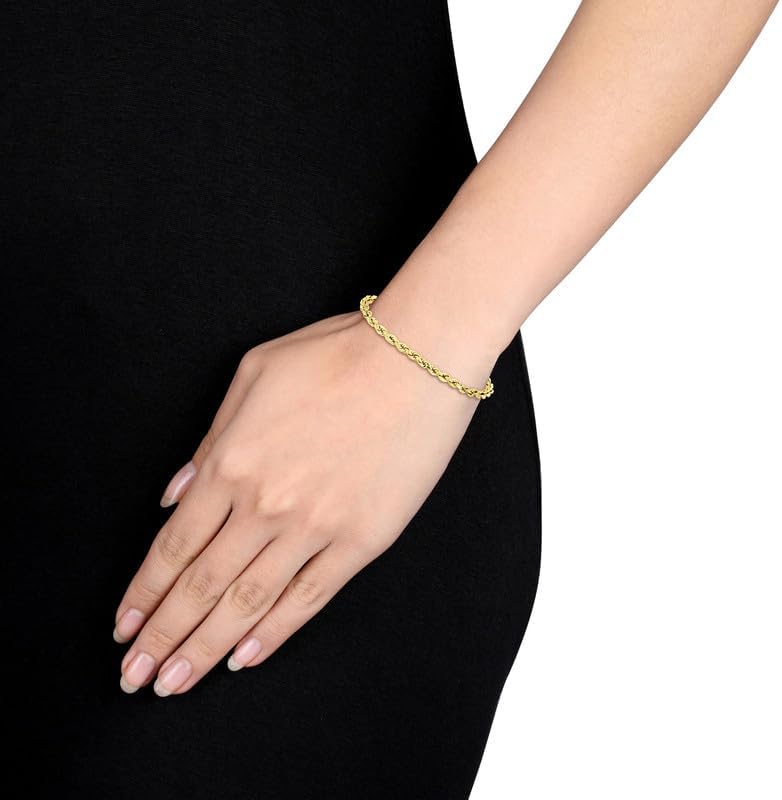
When someone sells you a “gold bracelet” for $35, they’re almost certainly not lying — but they’re leaving out a lot. That bracelet is probably gold-plated: a base metal (usually brass or copper) with a microscopically thin wash of gold on the surface. It looks identical to solid gold on day one. By month six, it tells a different story. Solid gold — meaning the metal is the same alloy all the way through — doesn’t fade, doesn’t turn your wrist green, and doesn’t lose its finish in the shower. The trade-off is price: a solid bracelet costs more upfront and is worth every structural reason why. This guide is for buyers who already understand that plated and filled pieces exist, and who are now deciding whether 10-karat (10K) or 14-karat (14K) solid gold makes sense for their budget, their use case, and their long-term math. We synthesize what metallurgists, long-term owners, and industry sources report — we haven’t worn or bench-tested these pieces ourselves, but we’ve done the homework so the decision framework is clear.
What “Karat” Actually Means in Purchase Terms
Karat (abbreviated K or kt in the U.S.) measures the proportion of pure gold in an alloy. Pure gold is 24K. Every number below that tells you how many parts out of 24 are actual gold — the rest is a mix of metals like silver, copper, zinc, or palladium that add hardness, color, and affordability.
By the Numbers
| Karat | Gold Content | Typical U.S. Bracelet Price Range (May 2026) | Hallmark Stamp |
|---|---|---|---|
| 10K | 41.7% gold | $150–$450 (chain/bangle, avg. 3–8g) | 10K, 417 |
| 14K | 58.3% gold | $350–$1,100 (chain/bangle, avg. 3–8g) | 14K, 585 |
| 18K | 75.0% gold | $700–$2,200+ (chain/bangle, avg. 3–8g) | 18K, 750 |
Prices above are synthesized from current retail listings and reflect spot gold near $3,200/troy oz as of mid-2026. They are ranges, not guarantees — weight, construction, and brand premium all move the needle.
The FTC Jewelry Guides (16 CFR Part 23) require that any bracelet sold as “gold” in the United States be at least 10K — which is why you won’t see 8K sold as simply “gold” in American retail the way you might in European markets. The GIA’s educational resource on gold jewelry alloys notes that 10K and 14K dominate U.S. commercial production precisely because they hit the durability-value crossover that everyday wear demands.
10K vs. 14K: The Tradeoff Is Real, Not Just Marketing
Here’s where a lot of buyers get stuck: they assume 14K is always “better” and 10K is a compromise. That framing is too simple. The honest version is that each karat grade optimizes for different things.
10K is not a downgrade — it’s a different engineering choice.
At 41.7% gold content, 10K has more alloy metals than gold. That sounds reductive, but those alloy metals — primarily copper and silver — make the bracelet significantly harder and more scratch-resistant than higher-karat options. Long-term owners of 10K chains and sport-style bangles consistently report that 10K holds up to daily rough wear — gym use, frequent hand-washing, contact with other jewelry in a dish — better than 14K in the same construction. The Knot’s karat guide explicitly notes that 10K is the most durable common gold option for everyday jewelry precisely because of its higher alloy content.
The counterarguments for 10K are two: skin sensitivity and resale. The higher alloy content (specifically copper and nickel, where nickel is used) can trigger reactions in people with metal sensitivities. And if you ever want to sell or repurpose the piece, the melt value is lower — at a $3,200/troy oz spot price, a 5-gram 10K bracelet has roughly $215 in metal content versus roughly $300 in a 14K piece of the same weight. That gap matters if you’re thinking of the bracelet as a store of value, not just an object to wear.
14K is the sweet spot for most fine jewelry buyers — and here’s why.
At 58.3% gold, 14K crosses a practical threshold: it has enough gold to be warm in color and relatively hypoallergenic (nickel is rarely used in quality 14K alloys), while still being hard enough for daily wear. Harper’s Bazaar’s roundup of gold jewelry investment pieces describes 14K as “the industry standard for fine jewelry that actually gets worn” — which captures the practical reality. It also photographs richer than 10K in yellow gold, which matters if a bracelet is going into a gift context where presentation counts.
The core tradeoff table looks like this:
- Choose 10K when: Budget is the hard constraint, the piece is for genuinely rough daily use (think: a chain bracelet worn during physical work or sports), or you’re building a stack where you want filler pieces that cost less without looking visually different.
- Choose 14K when: Longevity of finish is the priority, the piece is a gift or milestone purchase where metal quality is part of the statement, skin sensitivity is a possibility, or you want the bracelet to hold meaningful melt value over a decade.
Construction Signals That Matter More Than Karat Alone
Buyers who focus entirely on karat grade and miss construction are solving the wrong equation. A 14K hollow-tube bangle will dent in your car door. A 14K solid-core rope chain will outlast the clasp that came with it. Vogue’s bracelet coverage consistently returns to one point: construction quality at the mid-market tier ($350–$1,100) varies more widely than karat grade does, and the difference is harder to see in a product photo.
What to look for in solid gold construction:
Weight-to-price ratio as a sanity check. At mid-2026 spot prices, a 14K bracelet weighing 5 grams has roughly $300 in gold content before any markup for labor, design, or retail margin. If a “14K” bracelet at that weight is priced at $85, something is wrong with either the weight claim or the karat stamp. Legitimate sellers will provide gram weight — if a listing omits it, that omission itself is a signal. Ask. Any honest jeweler will tell you.
Clasp engineering is the most under-discussed quality signal in fine jewelry. This point deserves directness: the clasp is the most mechanically stressed component of a bracelet. A lobster-claw clasp on a fine chain should have a spring that snaps with clear resistance. Fold-over box clasps on bangles and cuffs should engage with an audible click and require deliberate pressure to release. Owners of pieces from established mid-market makers — Gorjana’s solid gold line, Mejuri’s 14K offerings, and independent goldsmiths in the $500–$900 range — frequently note that clasp failure, not metal wear, is the first failure mode on pieces that don’t earn their price.
Solid vs. hollow. A solid gold bracelet has the alloy throughout. A hollow piece (common in larger-gauge bangles and some wide cuffs) has an air pocket inside, reducing weight and cost. Hollow gold is still real gold, but it dents and deforms under pressure that solid construction would survive. The FTC does not require hollow disclosure in standard retail, so buyers need to ask directly or look at the price-to-weight ratio: a very light, large-looking piece at a suspiciously accessible price is often hollow.
Hallmark literacy. Every legitimate U.S.-market solid gold piece should have a stamp: 10K/417 or 14K/585, often alongside a maker’s mark. On a bracelet, this is usually on the clasp hardware or the interior of a bangle. If you’re evaluating an inherited or vintage piece and the stamp reads only “GF” (gold-filled) or “1/20 14K” (indicating gold-filled, meaning a mechanical bonding of gold layer to base metal, not solid gold), the metal value calculation changes entirely. The GIA’s hallmarking resources are the clearest public reference for decoding unfamiliar stamps.
When the Designer Premium Is Justified (and When It Isn’t)
Vogue and Harper’s Bazaar both cover this tension regularly: a David Yurman or Tiffany & Co. bracelet in 14K carries a price that exceeds its gold content by a factor of three to ten. That gap is real, and it’s not fraud — it’s brand equity, design IP, craftsmanship standards, and resale liquidity in the secondary market. The question is whether you’re buying for those reasons or despite them.
The designer premium makes sense when: you are buying a specific design that exists only from that maker (Yurman’s cable motif, Tiffany’s T-wire), the recipient will recognize and care about the brand, you are purchasing for resale value stability, or you are buying at the fine tier ($1,500–$5,000+) where brand-supported resale markets exist and an independent goldsmith equivalent would be custom-priced anyway.
The designer premium does not make sense when: your primary goal is gold content per dollar, the piece is a workhorse daily-wear item where the brand mark will be invisible, or you are comparing a branded 14K chain against a solid 14K chain of identical construction from a reputable independent jeweler. In that scenario, the independent piece wins on value math every time.
The Knot’s buying guides note that for milestone gifts — anniversaries, push presents, graduations — the brand context often serves a real emotional function: the box, the receipt, the story the recipient can tell. That function has value. Just know you’re paying for it alongside the metal.
The Decision Framework
If you’ve read this far, you’re probably holding a real decision. Here is the clear if/then framing:
If your budget is under $300 and daily wearability is the priority: 10K solid gold is the honest answer. It outperforms 14K on durability at a lower price point and keeps you out of the plated/filled tier entirely. Prioritize weight and clasp construction over brand name.
If your budget is $350–$900 and the piece is a gift or a keeper: 14K solid gold is the correct tier. Look for disclosed gram weight, a documented hallmark, and a clasp mechanism that inspires confidence. Independent jewelers and mid-market brands with transparent material specs (Mejuri’s solid gold line, small goldsmiths with hallmark documentation) offer the best value-to-quality ratio here.
If your budget is $1,000+ and design or resale matters: 14K or 18K from an established brand earns its place at that price point — but verify the karat stamp, confirm the weight, and know going in how much of the price is metal versus brand equity. That split is information, not a reason to walk away; it’s just the honest cost of what you’re actually buying.
Solid gold is not a luxury for its own sake. It is the tier where the bracelet stops being a consumable and starts being an object with a useful life measured in decades. The math supports it. The construction signals tell you how to find the ones worth buying at every price within that tier.