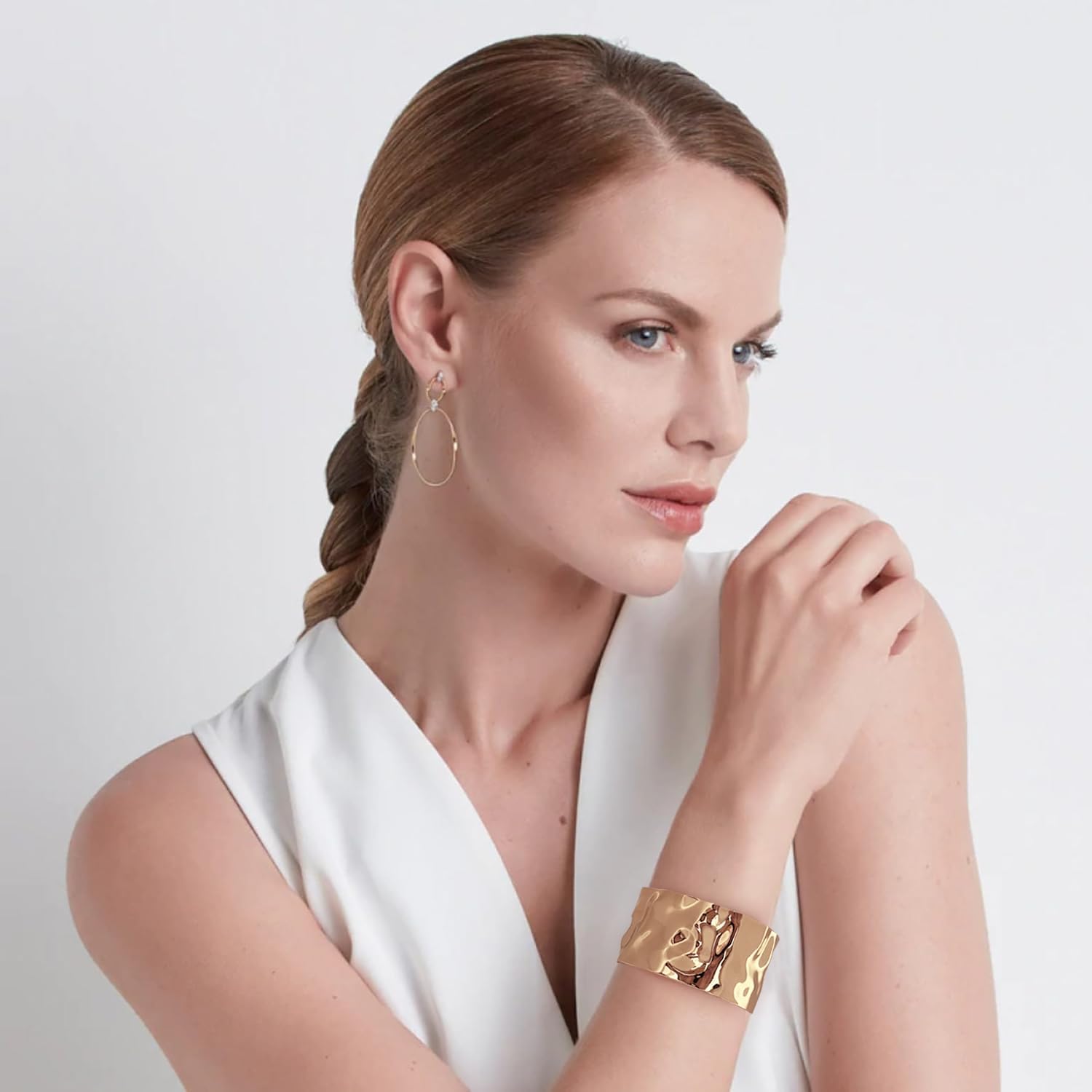
An open cuff bracelet is exactly what it sounds like: a rigid or semi-rigid band of metal — usually gold, silver, or a plated base metal — formed into a C-shape with a gap that lets you slide it onto your wrist without a clasp. That gap is also what makes them deceptively tricky. Because there’s no hinge or lock, the fit depends entirely on how the metal was shaped at the factory, how thick the metal wall is (what jewelers call gauge), and whether whoever put the bracelet on actually knows how to open and close it correctly. Get those three variables right, and an open cuff can be the most wearable, most style-versatile bracelet you own. Get them wrong, and you’ll be left with a warped oval that either slides off your hand or leaves a bruise — or both. This guide breaks down every variable that determines whether an open cuff performs or fails, with enough specificity to help you shop confidently and avoid the most common damage patterns owners report across every price tier.
Why Gauge Is the Most Under-Discussed Variable in Open Cuff Buying
When buyers research open cuffs, they focus on karat grade (how pure the gold is) and design. Those matter — but gauge, the thickness of the metal wall or wire, is what actually determines whether the cuff holds its shape over years of real use.
Gauge in jewelry is typically expressed in millimeters for sheet-formed cuffs or in either millimeters or the American Wire Gauge (AWG) system for wire-formed styles. The relationship is counterintuitive: a lower AWG number means thicker wire. A 14-gauge wire cuff is substantially more rigid than an 18-gauge cuff in the same design. For practical purposes, most buyers should think in millimeters of wall thickness rather than AWG.
What the numbers look like in practice:
| Style | Typical Wall / Wire Thickness | Adjustment Tolerance |
|---|---|---|
| Delicate wire cuff (plated or vermeil) | 0.8 – 1.2 mm | Very low — one or two minor adjustments max |
| Mid-weight sheet cuff (10k–14k solid) | 1.5 – 2.0 mm | Moderate — resizable by a jeweler 2–3 times |
| Substantial sculptural cuff (14k–18k solid) | 2.5 mm+ | High — designed for long-term reshaping |
GIA’s published guidance on gold alloys notes that the mechanical properties of gold change meaningfully with karat — lower-karat alloys like 10k tend to be harder and more spring-resistant than 18k, which is softer and more workable but also more susceptible to fatigue if repeatedly flexed at the gap. That tradeoff matters directly for open cuffs: an 18k cuff from a luxury house may be more comfortable after professional sizing, but the gap area is where stress concentrates, and repeated amateur bending accelerates metal fatigue at exactly that point.
What owners report consistently across jewelry forums and long-term reviews: thin plated cuffs at the entry tier lose their circular profile fastest, usually within six to eighteen months of regular wear, because the base metal (often brass) has enough spring to resist casual reshaping but not enough rigidity to hold under everyday torque. The failure mode isn’t breakage — it’s permanent oval distortion that can’t be undone without a bench and a mandrel.
The Three Fit Variables That Determine Whether a Cuff Actually Works
Open cuffs fail for three distinct reasons, and they’re easy to conflate. Separating them makes shopping and adjustment decisions clearer.
1. Internal diameter vs. wrist circumference
The internal diameter of the cuff (the measurement across the inside of the C) needs to match your wrist’s widest point — typically the wrist bone itself — not your wrist circumference. Most cuffs are designed with an internal diameter of 55–65 mm, corresponding to the wrist measurement range most designers target. Harper’s Bazaar’s cuff sizing guidance recommends measuring the widest point of your wrist bone with a rigid ruler (not a cloth tape) and comparing directly to the internal diameter spec, not the circumference.
Where buyers go wrong: they apply ring-sizing logic — ordering by circumference — and end up with a cuff that clears the wrist bone but spins loosely or one that can’t clear it at all.
2. Gap width
The gap — the opening in the C — needs to be wide enough to pass over the wrist bone during on/off. Standard gaps run 25–35 mm. If the gap is narrower than roughly 25 mm, the bracelet requires meaningful flexing of the metal to get on, which is where damage begins. Vogue’s coverage of cuff bracelet construction notes that luxury houses intentionally design wider gaps (32 mm+) on sculptural statement cuffs to minimize the flex required at the gap — a decision that protects the metal’s geometry over years of use.
3. The taper problem
Wrists are not uniform cylinders — they taper from the wrist bone toward the hand and toward the forearm. A cuff with a circular cross-section will migrate toward whichever taper it fits most loosely. Oval or elliptical cuffs address this by matching the wrist’s actual geometry; a well-fitted oval cuff sits more securely with less migration than a perfectly circular one. The Knot’s jewelry gifting guide flags oval-formed cuffs as the more practical daily-wear choice precisely for this reason, even though circular cuffs photograph more cleanly in product shots and are therefore more common in entry-tier marketing.
How to Open, Adjust, and Close a Cuff Without Damaging It
This is where the most preventable damage happens, and where the practitioner-level decision lives: knowing which cuffs can be adjusted at home, which require a bench, and which should never be adjusted at all.
The correct motion is rotation, not spreading.
The instinct is to grab both ends of the cuff and pull them apart — widen the gap. That motion creates two stress points (one at each end of the gap) and creates asymmetrical force that permanently distorts the cuff into an oval or worse, a potato shape. The correct technique, documented consistently in jeweler training materials from Jewelers of America, is a twisting or rotational motion: hold the cuff at the 3 o’clock and 9 o’clock positions (not at the gap ends) and rotate one side toward you while the other rotates away. This distributes flex across the full arc of the cuff rather than concentrating it at the gap.
Gauge thresholds for home adjustment:
- Below 1.5 mm wall thickness: Do not adjust at home. The metal lacks the rigidity to recover from amateur reshaping. Slip it on at the widest point of your wrist without any spreading motion; if it doesn’t fit, it doesn’t fit.
- 1.5–2.0 mm: One careful rotation to open, one to close. If it takes more than two motion cycles to get it on, take it to a jeweler.
- 2.5 mm+: Solid-formed sculptural cuffs at this gauge can typically be adjusted professionally on a ring mandrel without structural risk. A skilled bench jeweler can resize these 2–3 times across the life of the piece.
The karat dimension:
Higher karat gold is softer. An 18k cuff at 1.8 mm thickness will fatigue faster under repeated flexing than a 14k cuff at the same thickness, because 18k’s higher gold content makes the alloy more ductile. This is not a reason to avoid 18k — it’s a reason to get the sizing right before you buy, rather than relying on adjustment latitude.
Price Tier Decision Framework: What to Prioritize at Each Investment Level
Because open cuffs are a construction-sensitive category, the right evaluation criteria shift as the price goes up. Here’s the explicit decision frame:
Entry tier ($20–$150, gold-plated or vermeil): At this tier, gauge is almost always thin — 0.8 to 1.2 mm — and the cuff is not meant to be adjusted. The purchase decision should turn almost entirely on fit as received. Measure your wrist bone diameter, match it to the internal diameter spec, and buy accordingly. Do not factor in “I can resize it” as a hedge. You cannot, practically. Brands like Gorjana and Mejuri’s vermeil line are honest about this constraint in their care documentation. Treat these as fashion-lifecycle pieces with a realistic wear window of 12–24 months of regular use before surface wear and shape drift degrade them.
Mid-market tier ($300–$800, solid 10k or 14k): Here, gauge starts to matter as a differentiating signal between pieces at similar price points. A solid 14k cuff with 2.0 mm wall thickness from a reputable manufacturer is a fundamentally different longevity proposition than a hollow 14k cuff at the same price. Ask specifically: is this solid or hollow? Hollow cuffs can be identified by their lighter-than-expected weight for the size and are not adjustable without risk of collapse at the seam. At this tier, professional sizing by a bench jeweler before first wear is worth the $30–$60 service fee — it extends the life of the piece meaningfully.
Fine and heirloom tier ($1,500–$5,000+): At David Yurman, Tiffany, or independent goldsmith quality, the design intent for fit is built into the piece. Yurman’s cable cuffs are engineered with specific gap geometries that the design team has balanced against wrist-bone clearance across standard size ranges. Owners consistently report that Yurman cuffs purchased in the correct size require minimal to no adjustment. If adjustment is needed, it belongs at the brand’s service counter or with a goldsmith who works in precious metals at this weight range. The metal value component also becomes meaningful: as of mid-2026, 14k gold spot derivative prices keep a substantial solid cuff in a range where professional care preserves both wear life and resale basis.
The decision rule:
If the cuff requires any flexing to get on your wrist at purchase, and it’s under 1.5 mm gauge, return it and size up — the metal will not survive repeated adjustment. If it’s above 2.0 mm solid gauge and requires a small adjustment, budget for a bench jeweler. If it’s a fine piece at 2.5 mm+, get it sized once, correctly, and it will outlast most other jewelry in your collection.
The Adjustment Mistakes That Cause Irreversible Damage
For completeness — and because these are the patterns most consistently flagged in owner long-term reviews and jeweler repair logs:
Spreading the gap with both hands at the gap ends. As described above, this is the highest-damage motion. It creates permanent oval distortion in delicate pieces and stress fractures at the gap edge in heavier ones.
Adjusting cold metal. Metal is marginally less workable in cold conditions. Jewelers warm metal before working it; if you’re adjusting a cuff at home in winter, warming it briefly in your palm before the motion reduces fracture risk at the gap.
Adjusting a hollow cuff at all. The seam where a hollow cuff’s metal sheet is joined is the weakest point in the structure. Any flexing motion can crack or collapse it. Hollow cuffs are not adjustable by any home method.
Repeated micro-adjustments. Each flex cycle — even a correct rotational one — work-hardens the metal at the flex point. Five small adjustments cause more cumulative fatigue than one larger adjustment. Commit to the size and make one deliberate adjustment rather than repeated small corrections.
Harper’s Bazaar’s bracelet care guidance recommends storing open cuffs on a cylindrical bracelet holder (a paper towel tube works) rather than loose in a jewelry box, specifically to prevent the weight of other jewelry distorting the cuff’s shape over time. It’s a low-effort preventive measure that experienced collectors consistently endorse.
Open cuffs reward the buyer who does the geometry homework upfront and punish the one who assumes flexibility is always an option. Get the internal diameter right, match it to a gauge that fits your adjustment intentions, and understand the motion before you put it on for the first time. Those three decisions account for the overwhelming majority of cuff longevity outcomes — and they’re all available to you before you spend a dollar.