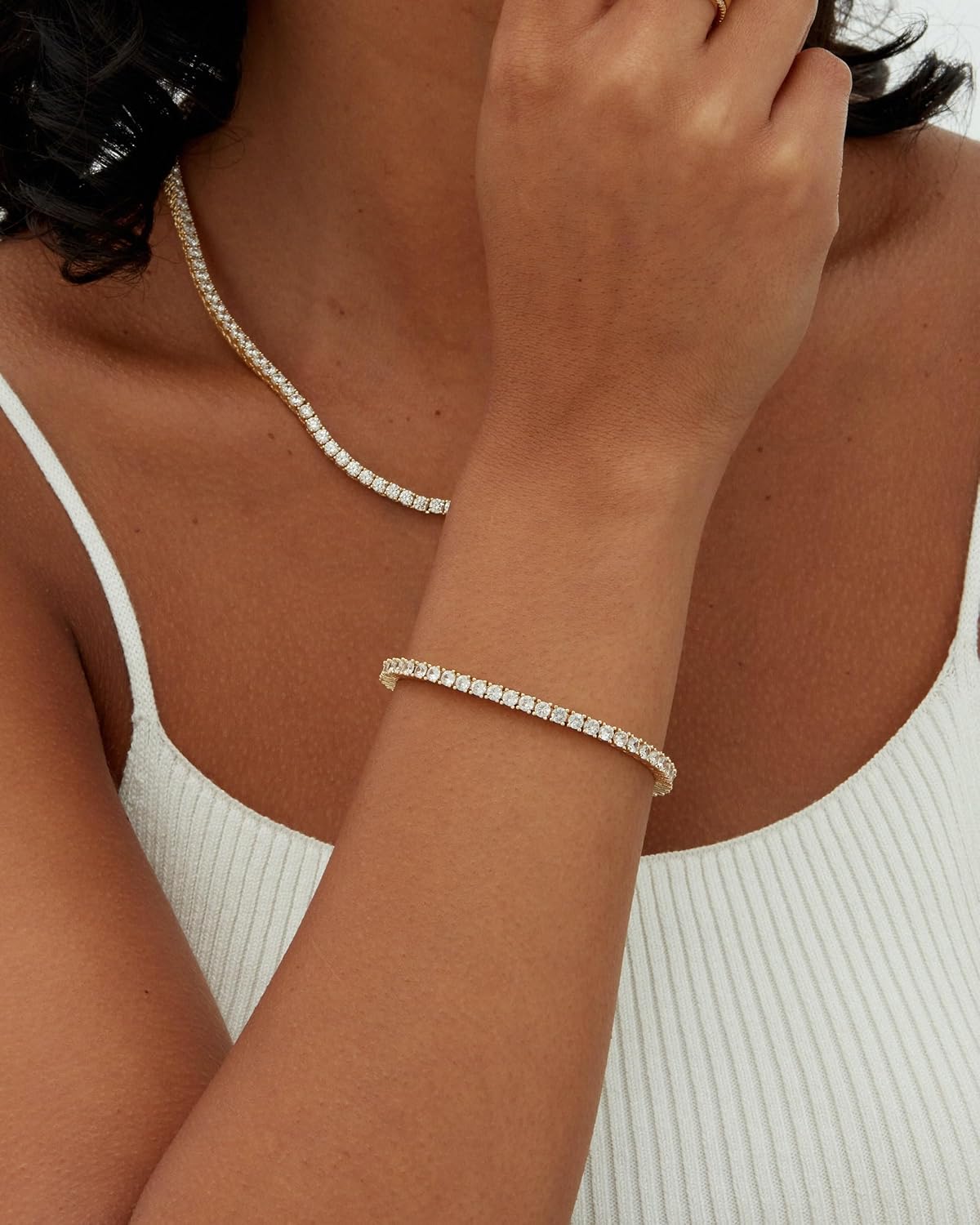
Buying someone a gold bracelet sounds simple until you’re standing in front of a browser tab with forty options and a tightening chest. What does “gold-filled” actually mean — is it real gold or not? Why does one chain cost $95 and another $950 when they look almost identical in the photo? And how do you size a bracelet for someone whose wrist you’ve never measured? These are reasonable questions, and the jewelry industry does almost nothing to answer them plainly. This guide does. We’ve synthesized what long-term owners report, what the FTC requires manufacturers to disclose, and what editors at publications like Vogue and The Knot consistently find when they survey the market — so you can match a budget to a construction tier, pick a size with confidence, and give a gift that holds up past the first wearing.
If you already know your karats from your vermeil, you’ll find the decision framework and comparison math you need by the second section. If this is your first time navigating this space, every term is defined the moment it appears.
Construction Tiers: What “Gold” Actually Means at Each Price Point
The single most important thing to understand before spending a dollar is that “gold bracelet” is a legal category with significant variation — not a single material. The Federal Trade Commission’s Guides for the Jewelry, Precious Metals, and Pewter Industries set minimum standards for what sellers can call each tier, and those standards have direct implications for how long a piece will look gold.
Gold-plated (also called gold electroplated) is a base metal — usually brass or copper — with a microscopically thin layer of gold deposited on the surface. The FTC allows a piece to be called gold-plated with a layer as thin as 0.5 microns. At that thickness, regular friction from skin, clothing, and water will wear through the gold within months to a year of daily wear. Entry-level price: $20–$80.
Vermeil (pronounced “ver-MAY”) is gold plating over sterling silver specifically, with at least 2.5 microns of gold at 10k or higher. Because the base is silver rather than brass, skin reactions are less common, and the slightly thicker gold layer lasts longer — typically 1–3 years of daily wear before noticeable wear-through. Brands like Mejuri and Gorjana build much of their entry-to-mid range here. Price: $80–$250.
Gold-filled is not the same as gold-plated despite the confusing name. Gold-filled items are legally required to contain at least 5% gold by weight, mechanically bonded under heat and pressure to the base metal. As Jewelry Shopping Guide’s breakdown of gold-filled construction notes, this bonding method means the gold layer is 50–100 times thicker than standard electroplating. Owners consistently report gold-filled pieces maintaining appearance for 10–30 years with normal care. Price: $60–$300, depending on design complexity.
Solid gold means the entire piece is a gold alloy — no base metal core. Karat (abbreviated “k” or “kt”) tells you what fraction of that alloy is pure gold: 10k is 41.7% gold, 14k is 58.3%, 18k is 75%, and 24k is 99.9% pure. For everyday bracelets, 14k is the most widely recommended karat by jewelers and editors alike — Vogue’s bracelet coverage repeatedly positions 14k as the durability-and-richness sweet spot, noting that 18k’s higher gold content makes it slightly softer and more prone to surface scratching under daily wear. Solid 10k or 14k chains and bangles: $300–$1,200. Solid 14k or 18k designer pieces (David Yurman, Tiffany, Cartier): $1,500–$5,000+.
The Quick-Reference Tier Table
| Construction | Gold Content | Typical Lifespan (Daily Wear) | Realistic Price Range |
|---|---|---|---|
| Gold-plated | <0.5% by weight | Months to ~1 year | $20–$80 |
| Vermeil | Thin layer, silver base | 1–3 years | $80–$250 |
| Gold-filled | ≥5% by weight | 10–30 years | $60–$300 |
| Solid 10k | 41.7% gold | Generational | $300–$600 |
| Solid 14k | 58.3% gold | Generational | $400–$1,200+ |
| Solid 18k | 75% gold | Generational | $800–$5,000+ |
What Each Budget Actually Gets: Decision Frames by Tier
Knowing the construction tiers is only useful if you can map them to a gifting scenario. Here’s how to think about each range as a decision, not just a price.
$20–$150: The occasion gift, not the heirloom. At this tier, you’re buying appearance and sentiment, not metal value. Gold-plated and vermeil pieces in this range — chains from brands like Gorjana, BaubleBar, or Amazon’s house brands — photograph beautifully and feel meaningful to receive. The honest trade is this: if the recipient wears it daily, it will show wear within a year. This is the right tier for a birthday gift to someone you’re not yet sure about their metal preferences, a stocking stuffer with real aesthetic thoughtfulness, or a piece the recipient will swap in and out of rotation. Do not present it as an investment or a permanent piece.
$150–$500: The gold-filled and entry solid-gold zone. This is where gifting starts to have a durability story. A well-made gold-filled chain or bangle — 14k gold-filled from a brand with transparent construction — will outlast almost any occasion it marks. At the upper end of this range, you enter solid 10k territory: real gold, real hallmarks, real resale floor. The Knot’s gift guidance for milestone occasions consistently places solid 10k or quality gold-filled in this sweet spot for “meaningful but not terrifying” gifting. Decision rule: if the occasion is a birthday or graduation and you want the piece to still look new in five years, spend past $150 and target gold-filled or 10k solid.
$500–$1,500: Solid 14k, where the gift becomes a possession. This is the range where a bracelet stops being an accessory and starts being an asset. A solid 14k cable chain or bangle carries intrinsic metal value — at May 2026 gold spot prices hovering near $3,200 per troy ounce, a 5-gram 14k bracelet has a melt value of approximately $295 in gold alone. The craftwork premium above that is justified by finishing, clasp engineering, and brand trust. At this tier, the recipient keeps this piece, likely passes it on. Gifting occasions where this is appropriate: anniversaries (5th, 10th, 25th), push presents, significant birthdays (30th, 40th, 50th). Do the math before you buy: ask the retailer for the gram weight and check it against current spot. A bracelet priced at $700 with a gold melt value of $600 is fairly priced. One priced at $700 with $90 in gold content needs to justify the remainder in design or brand equity.
$1,500–$5,000+: Designer fine jewelry, where you’re paying for both metal and legacy. At this tier — David Yurman’s cable cuffs, Tiffany’s T bangles, Cartier’s Love bracelet — the gold content is real and substantial, but you’re also purchasing a design language, a hallmark that communicates to other jewelry literates, and a resale market. Brides’ coverage of fine jewelry gifting for weddings and anniversaries notes that pieces in this range regularly appear as heirloom transfers between generations. GIA’s educational materials on gold karat and metal quality point out that 18k pieces in this tier hold closer to spot value but also command higher artisan premiums. Decision rule here is simpler than it looks: if the recipient recognizes and values the house (Yurman, Tiffany, Cartier, VCA), the premium is the point. If they don’t, buy a superior solid 14k piece from an independent goldsmith for half the price and twice the metal weight.
Sizing Without a Measurement: The Practical Framework
Wrist sizing is where gifting anxiety concentrates. The good news: bracelet sizing is more forgiving than ring sizing, and there are practical workarounds for gifting blind.
Standard sizing for women’s bracelets runs 6.5 inches (snug fit, small wrist) to 7.5 inches (standard fit, average wrist) to 8 inches (relaxed fit or larger wrist). The Knot’s bracelet sizing guidance identifies 7 inches as the statistical median for adult women in the U.S., making it the lowest-risk blind gift size for most chain bracelets and bangles.
For bangles specifically, the relevant measurement is hand circumference at the knuckles (the narrowest point a bangle must pass over), not wrist circumference. A standard women’s bangle interior diameter of 2.5–2.6 inches fits the majority of adult women; 2.75 inches fits larger hands comfortably. If you can discreetly measure one of the recipient’s existing bracelets or bangles with a soft tape measure, that’s more reliable than any estimate.
The adjustable-chain workaround is worth knowing. Many chain bracelets at the entry and mid tiers include an extender chain — an additional 1–1.5 inches of links that allow the wearer to adjust fit. For blind gifting, prioritize pieces with extenders. If you’re spending $800 on a solid gold chain, ask specifically whether it includes an extender or whether the length can be adjusted by the retailer post-purchase; most fine jewelers will resize a chain for free or a nominal fee.
Clasp Engineering: The Quality Signal Nobody Talks About
A bracelet’s clasp is the most mechanically stressed component on the piece, and it’s the most reliable proxy for overall construction quality that you can evaluate from a product listing.
Lobster claw clasps are the fine jewelry standard for chains — a spring-loaded mechanism that opens under thumb pressure and snaps closed. Well-made lobster clasps from quality manufacturers are rated to hold reliably through years of daily use; owners of solid gold chains with quality lobster clasps consistently report no failures over 5–10 years of wear.
Toggle clasps (a bar that passes through a ring) are design-forward but functionally inferior for daily wear on heavier chains. They rely on gravity and chain weight to stay closed, meaning an active lifestyle or a light chain increases failure risk. Reviewers at both Vogue and Who What Wear have flagged toggle clasps as a source of loss in reader feedback on chain bracelets.
Spring ring clasps — smaller circular spring mechanisms — are common on lower-price pieces and are generally considered less durable than lobster clasps for chains over 4mm width. On delicate 1–2mm chains in vermeil or gold-filled, they’re acceptable.
Box clasps with safety latches appear on higher-end tennis bracelets and designer cuffs. When properly engineered, these are excellent; when cheaply made, the safety latch is the failure point. If you’re evaluating a piece with a box clasp over $500, check whether owners report clasp failures in reviews — this is one of the more common complaints in the mid-designer tier.
Decision rule on clasps: at $300 and above, a lobster claw or well-engineered box clasp with safety is the minimum to accept. A toggle or spring ring on a $600 chain is a construction red flag regardless of how the gold reads.
If X, Then Y: The Gifting Decision Tree
The practitioner version of this guide ends with explicit rules, not vibes.
- If budget is under $150 and the occasion is casual or exploratory → buy gold-filled or quality vermeil, name the construction honestly, set expectations.
- If budget is $150–$500 and durability matters → target gold-filled or solid 10k; ask for gram weight before purchasing.
- If budget is $500–$1,500 and the occasion is milestone → solid 14k is the correct tier; calculate melt value to validate pricing; prioritize lobster clasp construction.
- If budget is $1,500+ and the recipient knows fine jewelry houses → the designer premium is the gift; buy from an authorized retailer; verify hallmarks match the house standard.
- If budget is $1,500+ and the recipient does not follow designer jewelry → redirect to an independent goldsmith or estate market; you’ll get more gold for the money and a piece with equal longevity.
- If sizing is unknown → default to 7 inches with extender for chain bracelets; 2.5-inch interior diameter for bangles; ask retailer about post-purchase resizing before checkout.
The gold bracelet gifting decision doesn’t have to be a guess. The tiers are real, the math is accessible, and the construction signals are legible once you know where to look. Match the tier to the occasion’s emotional weight, verify the construction before you commit, and the piece will carry exactly the meaning you intended.