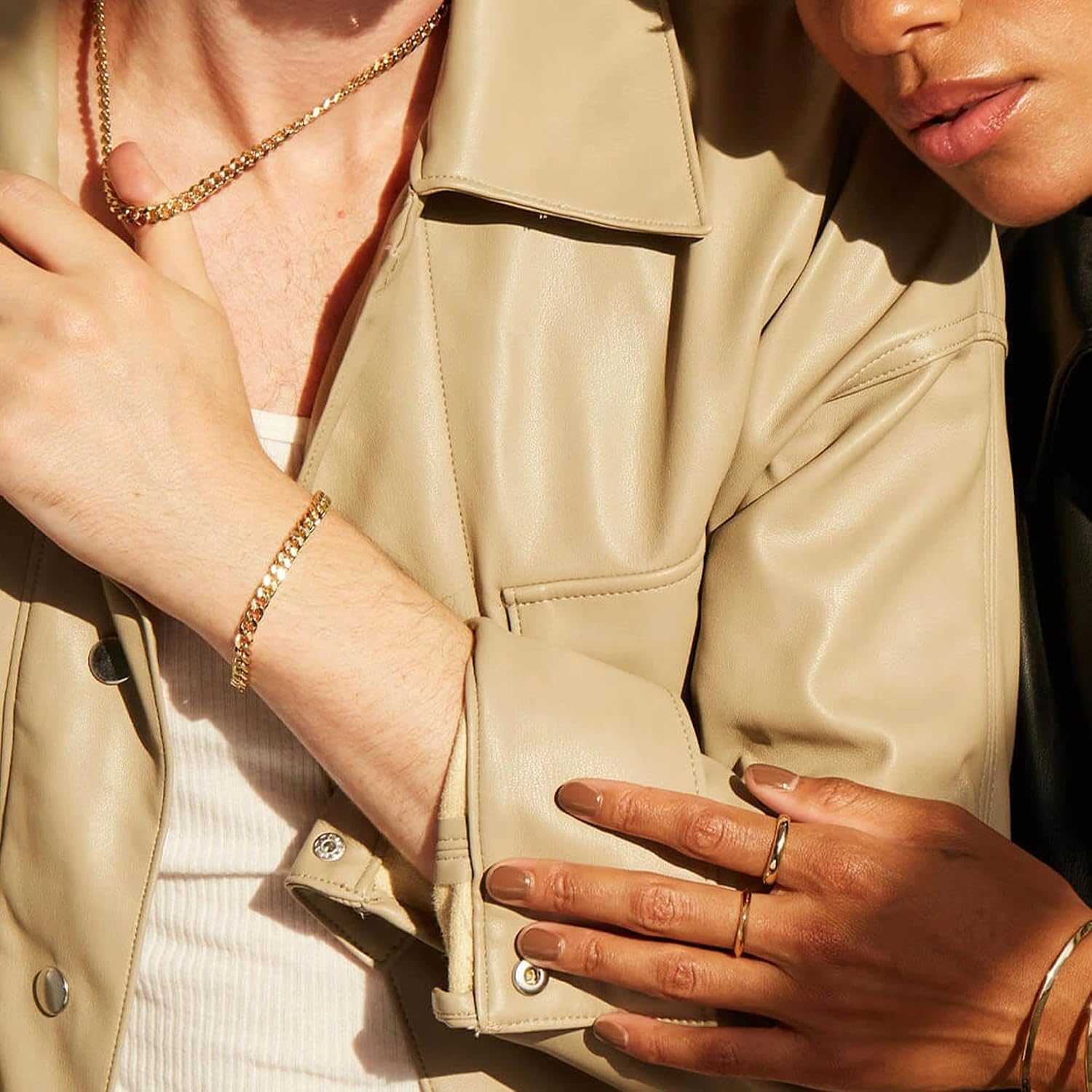
If you have ever picked up a wide, interlocking gold chain bracelet and felt that satisfying heft in your palm, you already understand why Cuban links have moved from hip-hop iconography into mainstream fine jewelry. A Cuban link is a style of chain where flat, oval links are woven so tightly together that the surface looks almost like armor — smooth on top, visually bold, and noticeably heavy compared to a delicate rope or tennis bracelet. “Chunky chain” is the broader category: any statement bracelet where the individual links are wide enough (typically 8mm and up) that the chain itself is the design. What separates a $45 buy from a $1,200 one isn’t always visible to the naked eye on a product photo — it lives in the metal grade, the construction method, and the weight per inch. This guide breaks all of that down so you can make the call with confidence, whether your budget is $80 or $800.
What “14K Gold Plated” Actually Means on a Chunky Chain — and Why It Matters More Here Than Anywhere Else
Let’s start with the most important concept in this category, because the phrase “14K gold plated” appears on thousands of chunky chain listings and it is genuinely misleading if you don’t know what the words mean.
Gold plated means a base metal — usually brass, copper, or a zinc alloy — has been electroplated with a thin layer of gold. The FTC Guides for the Jewelry, Precious Metals, and Pewter Industries (16 CFR Part 23) do not specify a minimum thickness for a piece to be called “gold plated,” which is why quality varies so wildly. The “14K” descriptor tells you only the purity of the gold in that surface layer (14 parts gold out of 24, or 58.5% pure gold). It says nothing about how thick that layer is or how long it will last.
Why does this matter more on chunky chains than on, say, a dainty pendant? Surface area. A wide Cuban link bracelet has an enormous amount of metal exposed to skin oils, friction, moisture, and everyday abrasion. A plating layer that might last two years on a thin chain can wear through in six months on a bracelet that rubs against your wrist with every keyboard stroke. GIA’s guidance on gold jewelry construction notes that plating thickness is the dominant variable in longevity, not the karat designation on the surface layer.
The terminology hierarchy you need to hold in your head:
- Gold plated: Thin electroplated layer, no minimum FTC thickness. Base metal underneath. Expect color fade with regular wear, timeline varies by plating thickness (often measured in microns — look for 2.5 microns or higher for anything chunky).
- Gold vermeil (pronounced ver-MAY): Gold plated over sterling silver, with a minimum 2.5-micron thickness and minimum 10K gold per FTC standards. More durable than standard plating; base is non-reactive.
- Gold filled: A layer of solid karat gold mechanically bonded (not electroplated) to a base metal core. Must be at least 1/20th of the total metal weight per FTC rules. Dramatically more durable than plating. Brands like Gorjana use gold-filled construction at the entry price tier.
- Solid karat gold: The entire piece is the alloy (14K = 58.5% gold, 10K = 41.7% gold). The only option where there is no base metal to expose.
When a chunky chain listing says “14K gold plated,” it is not solid gold. When it says “solid 14K,” confirm by looking for a hallmark stamp — 585 (the European standard for 14K), 417 (10K), or simply “14K” — and buying from a seller who will provide documentation.
Width and Weight: The Numbers That Actually Tell You What You’re Buying
Chunky chain shopping is uniquely quantifiable. Unlike a ring or pendant where design complexity matters more, a Cuban link or wide chain bracelet’s quality signal lives in two numbers: width in millimeters and gram weight.
By the Numbers
| Width | Category | Typical solid 14K weight (7” bracelet) | Entry plated weight |
|---|---|---|---|
| 8–10mm | Entry chunky | 14–20g | 4–8g (hollow/plated) |
| 12–15mm | Statement | 22–38g | 6–12g |
| 18mm+ | Oversized / collector | 40g+ | 8–15g |
Weights are representative ranges synthesized from published spec sheets across multiple retailers; actual weight varies by link style and manufacturer.
The weight gap between a solid 14K piece and a plated piece of the same visual width is not subtle — it is often 3–4x. This matters practically: the heft of real gold is part of the wearing experience, and it’s also the most reliable informal quality check you can do in-store. A 14mm Cuban link bracelet that feels light enough to forget you’re wearing it is almost certainly not solid karat gold.
Vogue’s coverage of the Cuban link revival has consistently pointed to the 10–12mm range as the “sweet spot” for wearability — wide enough to read as a statement, narrow enough not to restrict movement. Who What Wear’s roundups of the best gold chain bracelets echo this, noting that pieces in the 10–14mm range from brands like Mejuri, Missoma, and newer independent goldsmiths have driven the category’s mainstream adoption since 2023.
Construction Methods: Hollow, Semi-Solid, and Why the Clasp Is Your Quality Tell
Even within the “solid gold” category, not all chunky chains are built the same way. The two main construction approaches:
Hollow construction: The links are formed from gold tubing, stamped, and assembled. The piece is technically solid karat gold (all the metal you see is the alloy) but the links are hollow inside. This dramatically reduces gram weight and cost — a hollow 14K bracelet can look identical to a semi-solid one in a photograph. It also reduces durability: hollow links can dent or collapse under pressure, and repairs are more difficult.
Semi-solid and solid construction: The links are formed from solid gold rod or sheet, giving you genuine mass. These pieces are heavier, pricier by gram, and far more resilient to daily wear. For a bracelet worn every day — which most Cuban links are, given the trend toward permanence and layering — semi-solid construction is the meaningful upgrade.
The Knot’s gold jewelry buying guide makes a point worth repeating here: the clasp is often the fastest quality indicator you can evaluate without any specialized knowledge. A box clasp with a figure-eight safety on a heavy chain is a sign that the manufacturer expected this bracelet to carry real weight and survive real use. A lobster clasp that feels flimsy relative to the chain’s bulk is a red flag regardless of what the metal stamp says. On a 14mm+ Cuban link, look specifically for:
- Box clasp with double safety (standard on better Italian-made chains)
- Hidden tongue clasp (common on high-end flat Figaro and Cuban styles)
- Lobster clasp rated for weight — the clasp barrel should feel substantial, not hollow
Harper’s Bazaar’s coverage of statement chain jewelry has noted that independent jewelers and Italian chain manufacturers are increasingly disclosing clasp construction in their product descriptions, specifically because educated buyers started asking — which tells you the industry has noticed that consumers in this category are paying attention.
The Decision Framework: Entry, Mid-Market, and Fine
Here is the “if X, then Y” read on where to spend, based on what you’re actually optimizing for.
If your budget is $50–$200 and this is a trend purchase: Gold-plated brass or vermeil is a defensible choice — if you buy from a brand that discloses plating thickness (look for 2.5 microns minimum) and you understand it is a 1–3 year piece with regular wear. Brands like Gorjana (gold filled, more durable than plating) and Mejuri’s vermeil line (sterling silver base, disclosed micron thickness) are the better-constructed options in this tier. Avoid un-branded “14K gold plated” chains from unknown sellers where weight feels suspiciously low — that is usually very thin plating over cheap base metal.
If your budget is $300–$800 and you want daily wear that holds up: This is the solid 10K or 14K entry zone for chunky chains. At this price point you can find semi-solid 14K Cuban links in the 8–12mm range from mid-market brands and local jewelers. The gram-weight math helps you calibrate: as of mid-2026, gold spot price has remained elevated, making 14K raw gold cost roughly $45–$55 per gram (the 58.5% gold content of a gram of 14K alloy priced against spot). A 20-gram solid 14K bracelet has approximately $900–$1,100 in metal value alone, so a $600 piece at that weight would be below melt value — which almost certainly means it is hollow, lighter than claimed, or a lower karat than marked. Do the math before you buy.
If your budget is $1,200+ and you’re buying for longevity or gifting: You’re now in the range where independent goldsmiths and established chain manufacturers offer semi-solid to fully solid 14K construction with verifiable hallmarks, documentation, and repair warranties. At this tier, the conversation shifts to Italian versus domestic manufacture, link style (Miami Cuban vs. Franco vs. flat Figaro), and whether you want a piece that can be resized or repaired in 20 years. Ask for the gram weight in writing. Ask about the clasp mechanism. If a seller at this price point can’t answer both questions without hesitation, that tells you something.
Hallmark Literacy for Chunky Chains
One practical note before you close any purchase: chunky chains are wide enough that hallmarks are usually stamped on the clasp itself or on a small tag attached to the clasp. On a Cuban link, look for:
- 585 = 14K gold (European standard, common on Italian chains)
- 417 = 10K gold
- 14K or 14KT = domestic U.S. standard mark
- GF after a karat designation (e.g., “1/20 14K GF”) = gold filled, not solid
- GP or GEP = gold plated or gold electroplate
GIA’s published resources on gold jewelry quality factors confirm that hallmark stamps in the U.S. are voluntary but industry-standard, and that reputable sellers will always provide them. If you can’t locate a stamp on a piece sold as solid gold, treat that as a material defect in the transaction.
The chunky chain category rewards the buyer who slows down long enough to ask two questions: what is the gram weight? and where is the hallmark? Everything else — the width, the link style, the finish — is aesthetics. Those two numbers are the truth of what you’re actually buying.