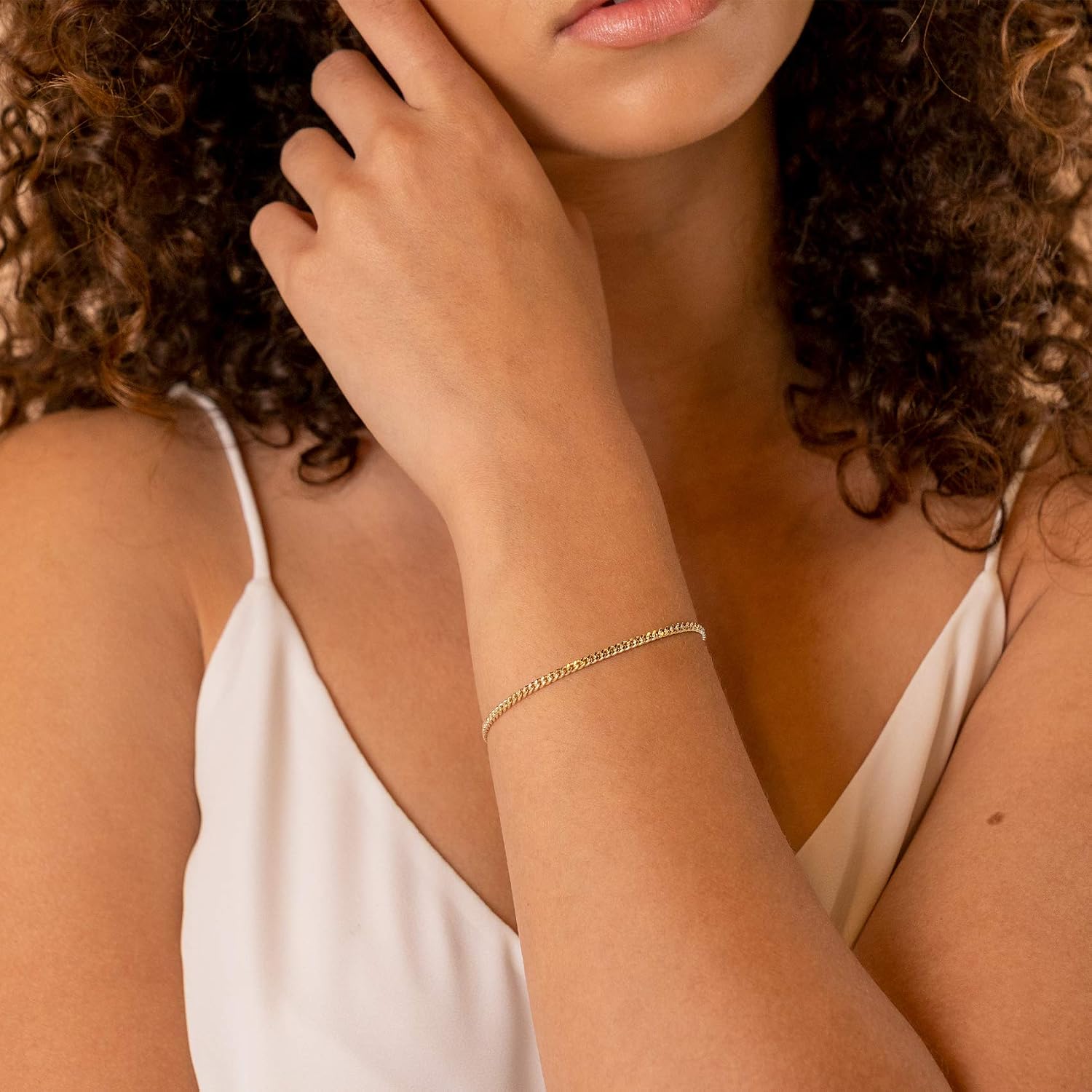
Chain-style names get thrown around on product pages as if everyone already knows what they mean — and most buyers quietly pretend they do. If you’ve ever nodded along while a sales associate said “this is a classic Figaro in 14k” and then spent the drive home Googling it, you’re not behind: the vocabulary just never gets properly explained. A gold bracelet chain is simply the linked structure that forms the bracelet itself, and the style name describes how those links are shaped and connected. That geometry turns out to matter a lot — it affects how the bracelet drapes, how it holds up to daily wear, how much gold is actually in it (which directly affects price), and whether it can be repaired without a bench jeweler losing their mind. This guide walks through every chain style you’re likely to encounter, tells you what owners and long-term reviewers consistently report about each one, and ends with a plain decision rule so you can match style to situation without second-guessing.
| EDITOR'S PICK[14K Gold Rope Bracelets](https://www.amazon.com/dp/B0CR5S3JVQ?tag=greenflower20-20) | Mid-tier[PAVOI 14K Gold Plated Paperclip](https://www.amazon.com/dp/B08PC58G7R?tag=greenflower20-20)… | Budget pickNOKMIT 14K Gold Filled Figaro B… | |
|---|---|---|---|
| Metal Purity | 14K | 14K Gold Plated | 14K Gold Filled |
| Chain Style | Rope | Paperclip/Curb/Figaro | Figaro |
| Width (mm) | 1.8 | — | 3/5 |
| Length (in) | 6-7 | Adjustable | 6.5-8.5 |
| Hypoallergenic | ✓ | — | ✓ |
| Non-Tarnish | ✓ | — | ✓ |
| Price | $120.00 | $16.95 | |
| See on Amazon → | See on Amazon → | See on Amazon → |
The Four Styles You’ll See in 80% of Listings
Paperclip
The paperclip chain — named exactly for what it looks like — is a series of elongated, rectangular open links lying flat. It became the dominant bracelet trend in the early 2020s and, according to trend coverage at Who What Wear, has held consistent commercial momentum well into the mid-decade because it reads as both minimal and architectural at the same time.
What owners consistently report: paperclip chains drape beautifully and lay flat against the wrist, which makes them excellent stackers. The open-link construction also means a jeweler can easily open one link to add a charm or resize the bracelet, which drives strong practical reviews among buyers who treat their bracelets as evolving pieces.
The tradeoff is structural: those elongated open links create more stress points than a tightly-woven style. Reviewers at Harper’s Bazaar and long-term owner commentary across fine jewelry forums note that lightweight paperclip bracelets — particularly gold-plated or vermeil versions under 2mm wide — show link distortion with aggressive daily wear. If you’re buying in solid 14k and at least 3mm width, that concern largely disappears. In plated metal, size up or reserve it for occasional wear.
Price logic: Because the links are open and relatively simple to fabricate, paperclip chains aren’t premium-priced for their construction — you’re paying for gold weight and karat. A 14k solid paperclip bracelet in the 3–4mm range runs roughly $300–$600 as of mid-2026 from mid-market brands. Vermeil versions start under $100 but carry the usual plating-longevity caveats.
Figaro
The Figaro is an Italian-origin pattern alternating one longer oval link with two or three shorter round links in a repeating sequence. The GIA’s jewelry description resources identify it as one of the oldest standardized chain patterns still in commercial production. You’ll recognize it immediately once you see it: the rhythm of the pattern is visually distinctive even at small scale.
Figaro is a workhorse style. It’s compact, lies flat, and the alternating link sizes distribute flex stress across multiple points rather than concentrating it — which is why experienced jewelers consistently recommend it as a durable everyday option. Owners who wear bracelets through physical work or frequent hand-washing report fewer kink and deformation complaints with Figaro than with paperclip or rope.
The Figaro also reads as more traditionally “fine jewelry” than some of the trend-driven styles. The Knot’s gold bracelet buying guide calls it a safe choice for gifting precisely because it telegraphs quality without being aggressively trendy — a meaningful signal if you’re buying for a recipient whose taste you know is classic.
Price logic: Figaro chains are mid-range to manufacture because the alternating pattern requires slightly more precision tooling than a uniform link. In 14k solid gold at a 4–5mm width for a bracelet, expect $350–$700 from reputable mid-market retailers. Width and link thickness drive price more than the pattern itself.
Cuban Link
The Cuban link — also called a curb link in some markets — is the heaviest and most architecturally dense of the mainstream chain styles. Each link is oval with a slight twist, and the links are connected so that the chain lies perfectly flat. The result is a substantial, interlocking structure that looks as good as it sounds in writing: visually bold, with serious perceived weight.
That weight is the point and the price driver. Because Cuban links are closely packed and often thicker-gauged than other styles, they contain significantly more gold per inch. A solid 14k Cuban link bracelet is one of the most metal-dense bracelet formats available outside of a solid bangle — which means it also holds the most intrinsic metal value relative to purchase price, a factor that Vogue’s fine jewelry investment guides flag as relevant for buyers treating jewelry as a partial store of value.
Owners consistently report that Cuban links are among the most durable everyday bracelet styles available — the interlocking flat geometry means there’s almost nowhere for individual links to catch, kink, or distort under normal wear. Repair technicians note that they’re also straightforward to work on because the link structure is standard and parts are widely available.
Price logic: Cuban links are priced on weight, and weight is high. A solid 10k Cuban link bracelet at 6–8mm width will typically run $400–$900; the same dimensions in 14k push to $700–$1,500+ depending on length and link thickness. If a Cuban link bracelet is priced like a paperclip at the same width and karat, verify the construction — hollow Cuban links exist and are common in lower price points, and long-term owners report they dent and flatten with regular contact.
Rope
The rope chain is constructed by twisting multiple small links in opposing helical directions, creating the visual texture of a twisted cord. It’s one of the most technically complex common chain styles to manufacture, and that complexity shows in two ways: the texture catches light at multiple angles simultaneously (which creates an especially bright visual presence), and the construction is more labor-intensive to produce and repair.
On durability: rope chains occupy a nuanced position in owner reporting. The twisted structure is actually quite strong under linear tension — you won’t pull one apart accidentally. But the interlocking twist means that if a section kinks sharply (say, caught in a closing drawer), it can be difficult to restore without professional attention. Harper’s Bazaar’s styling guidance and long-term owner consensus both recommend rope chains as “show pieces over daily beaters” — fine for regular wear if you’re mindful, but not the first choice for someone who treats their bracelet like a utility item.
The high surface area of a rope chain also means plating wears visibly faster on lower-karat versions — another reason to go solid if you’re investing in this style.
Price logic: Rope chains command a small construction premium because of manufacturing complexity, but the bigger cost driver is again gold weight. Solid 14k rope bracelets in the 3–4mm range run $350–$750 at mid-market; thin rope styles in gold-fill or vermeil start well under $100.
A Quick Numbers Check
Chain style at a glance — solid 14k, 7-inch bracelet, mid-market pricing (May 2026):
| Style | Typical Width | Approx. Price Range | Best For |
|---|---|---|---|
| Paperclip | 2–4mm | $200–$600 | Stacking, minimal aesthetics |
| Figaro | 3–5mm | $350–$700 | Classic gifting, everyday durability |
| Cuban Link | 5–10mm | $700–$1,500+ | Bold wear, high metal value retention |
| Rope | 2–5mm | $350–$750 | Light/texture play, statement pieces |
Ranges reflect solid gold mid-market retail, not hollow, plated, or filled constructions. Hollow versions typically price 40–60% lower and carry reduced durability and resale expectations.
What the Differences Actually Mean at Purchase Time
Hollow vs. Solid — the Most Important Qualifier
Chain style vocabulary is only useful once you’ve confirmed construction. Every style above exists in both solid and hollow formats, and the price and durability implications are significant. A hollow Cuban link can be indistinguishable visually from a solid one in a product photo; the weight difference is obvious in hand but not online. Ask the retailer explicitly, look for weight listed in grams, and cross-reference against published solid-gold estimates for that width and length.
The FTC’s rules on gold marking — which GIA’s educational resources summarize clearly — require that karat stamps reflect the actual gold content throughout the piece. “14k” on a hollow chain means the walls are 14k gold; it does not mean you’re getting the same gold weight as a solid chain of identical dimensions. That’s not fraud, but it’s a meaningful value difference that affects both durability and any future metal-value calculation.
Repairability as a Buying Signal
This one is under-discussed: some chain styles are straightforwardly repairable by any competent bench jeweler; others require style-specific expertise or replacement links that aren’t universally stocked. Figaro and Cuban are the most repair-friendly by broad consensus among working jewelers. Rope chains require more specialized attention. Paperclip is easy to work on structurally but can be harder to source matching links for distinctive designs.
If you’re buying for a recipient who will wear the piece hard and may not be near a major metropolitan jeweler, bias toward Figaro or Cuban. If this is a careful-wear piece or a collector’s item, rope and specialty paperclip designs are perfectly reasonable choices.
Stacking Logic
Who What Wear’s chain bracelet coverage and personal stylist guidance consistently point to one stacking principle: vary texture, not just weight. A paperclip (flat, open) stacks well with a rope (rounded, textured) or a thin Cuban (dense, flat). Stacking two rope chains of different widths reads as busy; stacking a rope with a cuff or a paperclip reads as intentional.
If you’re building a stack, think about the cross-section of each piece — flat-profile styles (paperclip, Cuban, Figaro) layer without tangling; round-profile styles (rope, box chains) can interlock and snag if worn too close in weight and width.
The Decision Rule
Chain style is, at base, a function of three variables: how the wearer actually lives in the bracelet, what aesthetic register they’re dressing in, and how much gold weight they want at a given price point.
If the bracelet will be worn daily with minimal thought → Figaro or Cuban link in solid gold. Both styles are durable, repair-friendly, and have decades of owner consensus behind them.
If the piece is for stacking or minimal, contemporary dressing → Paperclip in solid 14k at 3mm or wider. Below that width or in plated metal, reserve it for lighter rotation.
If visual impact and light-play matter more than utility → Rope chain in solid gold, sized to at least 3mm to carry the texture. Wear it with intention, not as a daily utility piece.
If metal value retention is part of the buying logic → Cuban link, solid construction, confirmed gram weight at purchase. It’s the closest a chain bracelet gets to a direct gold-weight investment without crossing into bullion territory.
Style names are the vocabulary; construction and karat are the substance. Once you’re fluent in both, the product page stops being noise.